Helga Ancher
Introduction
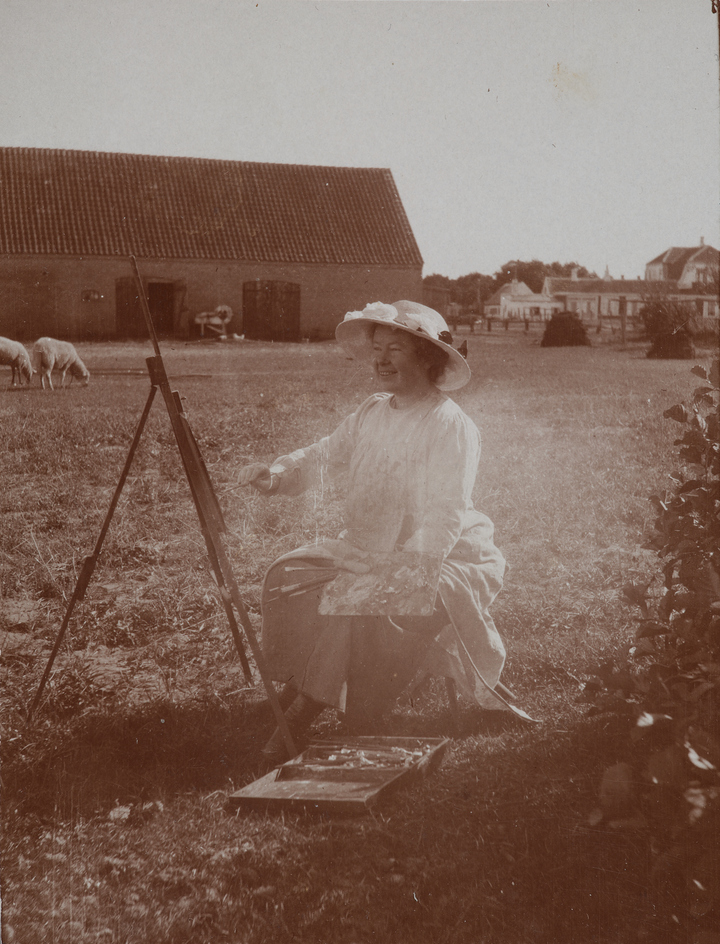 Helga Ancher in Front of the Easel. 1914. Unknown photographer. Skagens Museum, historic photo collection.
Helga Ancher's life story is almost indispensable when studying the artist colony in Skagen. Despite this, her life and work have only been sparsely explored and described. She was born in 1883, at the height of artistic activity in Skagen, and with a handful of her parents’ artist friends as godparents, the beginning of her life also marks the artistic heyday in Skagen. Helga’s own artistic ambitions were encouraged and supported by her parents and their friends, and refined through study trips to both Copenhagen and Paris. Her choice of motifs was divided between depictions of the familiar life in Skagen and the fantastical and mythological drawn from literature and theatre. Despite a lifelong connection to her hometown, her network reached far beyond. For example, she was closely connected to Johanne Feilberg and Elisabeth Dons, whose home in Copenhagen was a gathering point for many of the prominent cultural figures of the time.
In Skagen, Brøndums Hotel was the central meeting place where visiting artists lodged and where many of the artists’ social communities were rooted. It was also owned by Anna Ancher’s family – Helga’s mother was born Brøndum. From early childhood and throughout her life, the family-run hotel was like a second home to Helga. As the only child of the popular and much-sought-after artist couple, she spent much of her life with Anna’s family at the hotel. She was cared for by her grandmother and aunts for long periods when Anna and Michael were travelling. After Michael's death in 1927 and Anna’s in 1935, Helga, who had until then lived at home, moved into a room at the hotel. Since none of Anna’s five siblings had families of their own, Helga also inherited from them. With the death of her aunt Marie Brøndum in 1945, Helga was the last surviving member of the two great families.
After the death of her parents, Helga dedicated a significant part of her life to preserving their memory. She served as chair of the board of Skagens Museum for nearly 30 years (1935–64), led the founding of the Friends of Skagens Museum, and ensured above all that her parents’ home was preserved as an artist’s residence for future generations.
Through the presentation of selected archival materials and letters from friends and family, as well as her travels and childhood memories, not only does her life story and network emerge more clearly — we also gain a more nuanced insight into Helga Ancher as a person, as an artist, and as the last central figure of the Skagen artist colony.